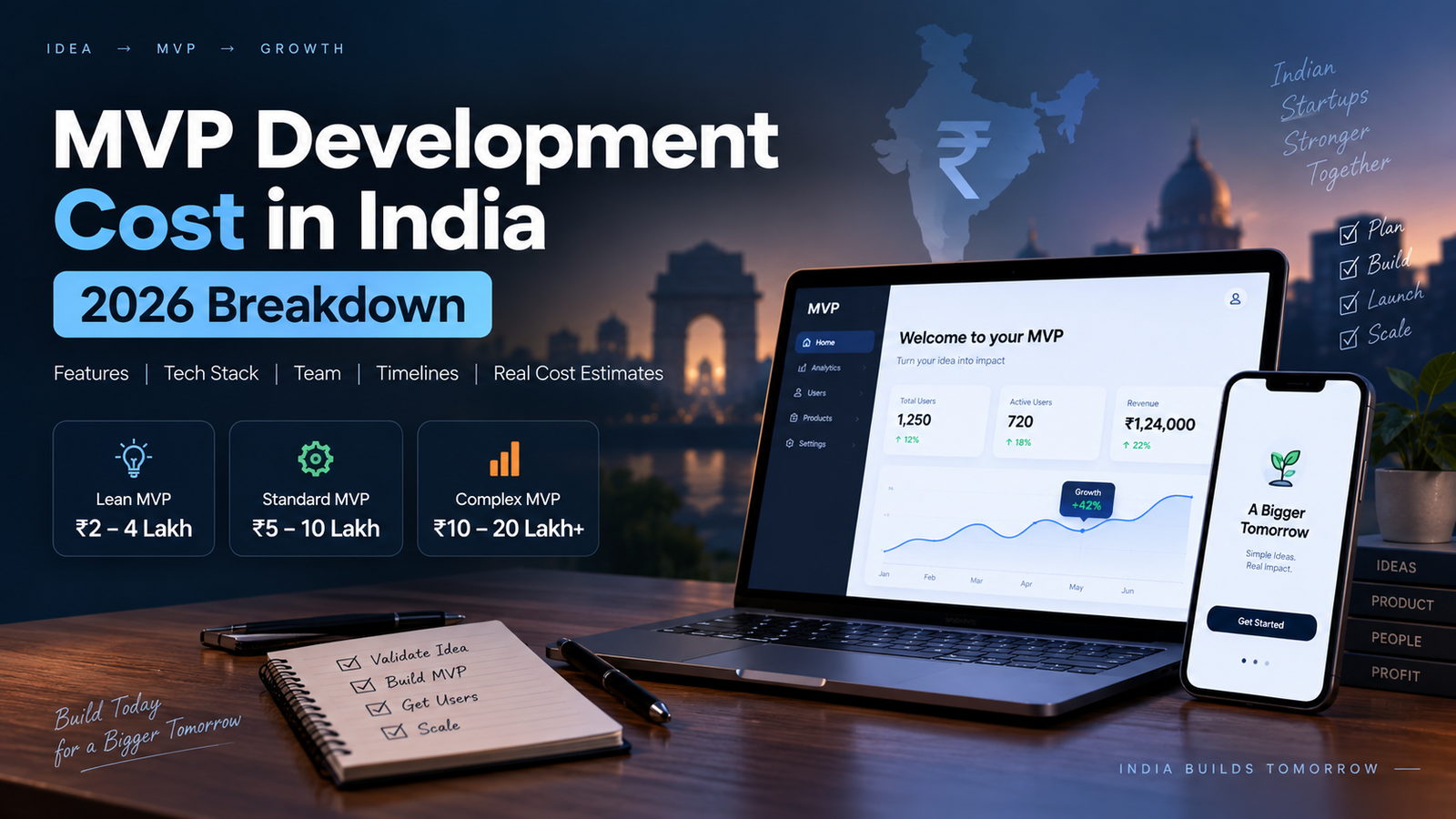
MVP Development Cost in India: 2026 Breakdown
Suggested meta description: A real breakdown of MVP development cost in India for 2026 — by complexity, by phase, and by team type — so you can budget before you talk to an agency.
Every founder asks the same question first: "What's this going to cost me?"
Most agency websites answer with a vague "it depends" and a contact form. That's not useful when you're trying to figure out if your idea needs ₹3 lakh or ₹30 lakh before you even start pitching investors or blocking your savings.
So here's an honest breakdown — what MVPs actually cost in India in 2026, what changes the number, and where the hidden costs usually show up.
Quick answer
For most startups building a custom-coded MVP in India, the realistic range is:
| MVP Type | Cost Range (INR) | Cost Range (USD) | Timeline |
|---|---|---|---|
| Basic MVP (1-3 core features) | ₹2,00,000 – ₹5,00,000 | $2,500 – $6,000 | 4-6 weeks |
| Standard MVP (full workflow, admin panel) | ₹5,00,000 – ₹15,00,000 | $6,000 – $18,000 | 6-10 weeks |
| Advanced MVP (AI, fintech, marketplace, compliance) | ₹15,00,000 – ₹40,00,000+ | $18,000 – $48,000+ | 10-18 weeks |
These numbers assume a custom-coded product built by a professional Indian dev team or studio — not a no-code prototype and not an enterprise build. If your MVP needs AI features, payment processing, or handles sensitive user data, expect to land toward the higher end of the "Advanced" tier regardless of how simple the UI looks.
Why the range is so wide
A "basic MVP" for a to-do list app and a "basic MVP" for a fintech lending platform are not the same project, even if both have three screens. Cost is driven by a handful of specific factors, not by vague complexity:
Number of user roles. A single-user app is cheaper than a two-sided marketplace where you're building separate experiences for buyers and sellers, plus an admin dashboard to manage both.
Third-party integrations. Payment gateways, SMS/OTP providers, maps, real-time tracking, and AI APIs each add development and testing time. A taxi-booking MVP with live GPS tracking costs meaningfully more than a static booking form, even with a similar screen count.
Platform choice. Web-only is cheapest. Web + one mobile app costs more. Native iOS and Android as two separate codebases costs the most — which is why most MVPs in India are built in Flutter or React Native to ship both platforms from one codebase.
Compliance requirements. Fintech and healthtech MVPs need data handling that meets RBI or health-data standards even at the MVP stage. That's not optional scope — it's baked into the architecture from day one, and it shows up in the price.
AI features. A basic chatbot wired to an FAQ document is a few days of work. A RAG pipeline that answers accurately from thousands of documents, with cost monitoring and fallback handling, is a different project entirely.
Cost by development phase
A full MVP budget isn't just "development." Here's roughly how it splits:
| Phase | What It Covers | % of Total Budget |
|---|---|---|
| Discovery & Scoping | Requirements, user flows, technical architecture | 5-10% |
| UI/UX Design | Wireframes, Figma design, design system | 10-15% |
| Core Development | Frontend, backend, database, API integrations | 55-65% |
| QA & Testing | Device testing, bug fixes, edge cases | 10-15% |
| Deployment & Handover | App store submission, server setup, documentation | 5-10% |
The most common mistake founders make is budgeting only for "development" and getting blindsided when design, QA, and deployment show up as separate costs later. A serious quote should include all five phases upfront.
India vs other regions: why the gap is real
| Region | Typical Hourly Rate (USD) | Mid-Complexity MVP Total |
|---|---|---|
| United States / Canada | $120 – $250 | $60,000 – $150,000 |
| Western Europe | $100 – $180 | $50,000 – $120,000 |
| Eastern Europe | $50 – $100 | $25,000 – $60,000 |
| India | $20 – $70 | $15,000 – $45,000 |
The gap isn't just labor cost arbitrage. Indian dev talent building for global startups is genuinely strong in Laravel, React, Flutter, and increasingly AI integration work — the rate difference reflects cost of living, not a quality gap. The real risk in India isn't quality, it's variance: the same MVP quoted at ₹3 lakh by one vendor and ₹15 lakh by another usually means one of them is cutting scope, not being more efficient.
Freelancer vs agency vs in-house: what actually changes
Freelancer. Cheapest upfront. Works well for a single, well-defined feature. Risk goes up if your MVP needs multiple disciplines (backend + Flutter + design) since you're coordinating people yourself, and there's no fallback if they disappear mid-project — which happens more often than founders expect.
Agency or studio. Costs more than a single freelancer but less risk. You get a team with overlapping skills, a defined process, and accountability for the full delivery — not just their piece of it. This is usually the right call for a founder who needs to focus on the business side, not project management.
In-house team. Makes sense once you've validated the idea and need to iterate fast for 12+ months. Almost never the right call for the first MVP — hiring, onboarding, and management overhead alone can exceed the entire cost of an outsourced MVP.
Hidden costs to ask about before you sign
These rarely show up in the first quote, and they're where budgets actually blow up:
- Third-party API and service costs (SMS gateways, payment processors, cloud hosting, AI API usage) — these are ongoing, not one-time, and most quotes don't separate them clearly
- App store fees — $99/year for Apple, $25 one-time for Google Play, plus review delays that can push your launch timeline
- Post-launch bug fixes — ask explicitly whether there's a bug-fix window included after handover, and for how long
- Scope changes mid-build — the single biggest source of budget overrun. A locked scope document before development starts is the only real protection against this
- A second design round — if the vendor doesn't get sign-off on Figma designs before coding starts, expect rework costs later
How we price MVPs at Plazmasoft
We quote off a written scope document, not a ballpark number on a call. The process is a free 45-minute discovery call, followed by a detailed scope covering every screen and API endpoint, which becomes the fixed-price contract. No scope inflation, no surprise line items at the end, and every MVP ships in two-week sprints with a working demo each time, so you see progress instead of status updates.
If you're trying to figure out where your idea actually falls in the ranges above, that's exactly what the discovery call is for — no pitch, just questions about what you're building and why.
Frequently asked questions
Is a cheaper MVP quote always a red flag? Not always, but ask what's excluded. A quote significantly below the ranges above usually means design, QA, or post-launch support isn't included — not that the vendor found a shortcut.
Can I build an MVP for under ₹2 lakh? Yes, with a no-code tool or a very narrow single-feature build. It won't scale past early validation, and you'll likely rebuild it once you have real users — which is fine if the goal is just testing demand fast.
Does AI increase MVP cost significantly? A simple AI feature (an FAQ chatbot, a classification tool) adds relatively little. A custom RAG system or fine-tuned model with production-grade monitoring adds meaningfully more — usually pushing a project into the Advanced tier.
How much should I budget beyond the initial quote? Plan for 15-20% beyond the fixed quote for post-launch iteration once real users start giving feedback. This is normal and expected — it's not a sign the initial scoping was wrong.